The Native Medicine Bag
A Medicine Bag is a traditional North American Indian vessel containing various items that its owner believed held supernatural power. The medicine man or shaman of a tribe would certainly carry one. It usually held many kinds of herbs, stones and other items used for his healing rituals. A personal medicine bag, carried by most Native American men, was not for healing others but it was used to maintain personal harmony with the physical, spiritual, and supernatural. A youth might have a small medicine bag, but as he added life experiences, he also added objects to his bag over the years. In time, he often needed to replace the bag with a larger one.
There were two very basic styles of American Indian bags: soft pouches, made of tanned animal hides (usually deerskin or elkskin), and parfleche, made of stiff rawhide.
As something that holds supernatural items, the medicine bag must also have some power of its own. Things that were added would typically include items related to a vision quest such as stones, fetishes, sweet grass, sage, bones, hair or fur, roots, leaves or feathers. Each of the items had a special significance in the life of the owner of the bag. The vision quest is a Native American ceremony that includes personal sacrifice: fasting and prayer over several days in a location isolated from the rest of the tribe. The purpose is to make contact with natural spiritual forces that help or guide people to reach their potential. The spirits would aid the individual to gather magical items to help increase knowledge and aid personal growth.
Typical powers ascribed to medicine bags and their items might include increasing hunting abilities and fighting skills, healing oneself and allies, hindering enemies and even altering the weather to more favorable conditions.
Today, non Native Americans also use Medicine Bags. They are symbols connected to personal protection and power. Some wear a small medicine bag around the neck or under the clothing, or they might hang it on a belt or saddle or carry it in a purse, pocket, knapsack or briefcase. Some people choose to sleep with their medicine bags under their pillows.
What the bag contains is considered sacred and good medicine for that person and that person alone. It can be traditional items or anything else important to the owner. Traditionally a medicine bag contains something from the plant, animal and mineral kingdoms and from the life of man. Examples:
Plant Kingdom
Sage and Sweetgrass
Corn, Bean, and Squash Seeds
Flowers
Animal Kingdom
Lock of hair, mane or tail
Bone or Tooth
Feather
Claw or Nail
Mineral Kingdom
Stone fetish
Piece of stone such as turquoise or lapis
Gem
Crystal
Man's World
Key
Photo
Coin
Bullet
quarta-feira, 10 de janeiro de 2018
LAKOTA: THE CONCEPT OF WAKAN
To try to describe the Lakota (Sioux) concept of "wakan" would be much like trying to put down a few paragraphs and accurately and amply sum up "God." It can't be done. Wakan is so faceted in nature it would be impossible to describe it all in words, but the following is an attempt to convey just a inkling of what it is all about.
In the world of the Lakota, the word wakan means many things, yet nothing that is easily understood. Even among the Lakota themselves a great deal of thought and study is necessary in a quest to understand the concept of wakan.
Those who travel among the Lakota hear them speak of their beliefs in wakan by many names: Wakan Tanka, Tunkashila, Taku SkanSkan, Great Spirit, Grandfather. The traveler might ask "Are these names for one being or for many?" The answer would have to be both.
To the Lakota, those which made everything are Wakan Tanka. Though wakan have separate meanings unto them selves, Wakan Tanka can be loosely interpreted as "wakan" as "mystery" and "tanka" as "something great." And being the "creators," the Wakan Tanka also are Wakanpi, those things above mankind. They are never born and they never die. The Wakanpi, spirits, have power over everything on earth and control everything mankind does. There are benevolent Wakanpi that will bestow the wishes man asks of them, and evil Wakanpi that are to be feared. and
Man uses songs, ceremony and gifts to honor and appease, all under the auspices of the holy man or shaman, wicasa wakan. Prayers offered to the wakan beings as a whole are addressed to Wakan Tanka, but prayers offered to a specific being should address the being by name.
Music is a good vehicle of prayer, and it is said the Wanka Tanka always give attention when they hear the drums and rattles. While the good wakan beings are fond of prayers that reach them on the smoke of sweetgrass, the evil wakan beings fear the smoke of sage. All the Wakan Tanka are pleased with the smoke of the Lakota pipe.
White culture sometimes refers to the Lakota medicine man as a "medicine man," or as the Lakota say, wicasa wakan, when he is performing ceremonies, and believe he is making medicine when doing so. This is incorrect because the Lakota call something a medicine only when it is being used to tend to the sick or injured, and so the proper term would be pejuta. So a man of medicine among the Lakota, a "doctor," is a pejuta wacasa, which is not to be confused with wicasa wakan, which is a holy man, or shaman. A wicasa wakan is wise, one who knows and has power with the spirits and can communicate with them. He knows the songs and the ceremonies and can interpret visions. He can tell people what the spirits expect of them, predict the future, speak to nature...to everything on earth. So one, the pejuta wacasa, tends to the physical being, while the other, wicasa wakan, tends to the spiritual.
When a holy man uses an object in a ceremony that object becomes filled with something that best be described, for lack of an actual English term, as "spirit." The Lakota use the term tonwan or ton to describe it. Ton is the power to do the supernatural. Rattle, smoke, feather...once anything has tonwicasa wakan has the power of wakan beings, bestowed upon him by wakanton has been placed, called a Wasicun, from which the shaman do their work from. White culture would probably call this a "medicine bag," which is incorrect because there is no "medicine" in it. White doctors or Lakota pejuta wacasa would have "medicine bags," not holy men. Wasicun is actually a wakan being too, but the least powerful of all. it becomes wakan because the spirit is said to have entered it. Therefore, a beings. With that power the holy man can put ton into anything. He also has a place of his own where
Like Wanka Tanka, which can be good or evil, this ton is not necessarily positive in the big picture either. For example, the roots of certain plants are wakan because they are poisonous or some reptiles are considered wakanwakan because the stories handed down from generation to generation have said the wakan beings made them so. A person acting out of the norm, appearing "crazy," is wakan. Even alcohol, which makes one "crazy," is wakan. On the other hand, food is wakan because it gives life. Very old things are wakan because their origin is a mystery. Babies are wakan because they do not speak. Every object in the world has a spirit and that spirit is wakan, good or evil, put there by Wanka Tanka, good or evil. because their bite can kill. Some animals are
Lame Deer served his people as a medicine man and ritual leader for many years and could easily be considered somewhat of an "expert" on concept and tradition among the Lakota. About Wakan Tanka he said:
You can't explain it except by going to the circles within circles idea, the spirit splitting itself up into stones, trees, tiny insects even, making them all wakan by his ever presence. And in turn all these myriad of things which make up the universe flowing back to their source, united in the one Grandfather spirit.
segunda-feira, 8 de janeiro de 2018
The Teaching of the Feather
There has always been an aura of mystique surrounding the Eagle for Aboriginal peoples. The Iyiniw or Nehiyaw has always deemed to honor this spirit from the animal world. It soared so high in the heavens that Iyiniw or Nehiyaw held it in high esteem since it was so much closer to the Creator. The Eagle became a power of vision, strength and courage. There are many special meanings and special uses for the Eagle.
It is common knowledge that Iyiniw or Nehiyaw depended on animals for knowledge of the world around them, the environment, of life and of themselves. Animals had a sense for changes in the world, the changing of seasons and of things to come. Iyiniw or Nehiyaw does not possess the animal sense. The Eagle was the leader in all those things and it represented foresight and courage. The relationship to the earth and nature has always been intimate and intensely personal for the Aboriginal peoples and because of the special relationship, they are closely related to sacred beliefs. The Creator had given each group of people tools for survival. We must trust ourselves to ensure that our needs are met.
The Cycle of Life is holistic. The Creator is the centre of all life. The life of a person follows a pattern of the seasons or pattern of a day, from childhood, to youth, adulthood, and old age. The completeness of a circle indicates no beginning and no end but eternity. The path of life calls for balance and harmony but there are no landmarks to guide from birth to death. The Iyiniw or Nehiyaw can only give an ideal interpretation as to how that could be done. It is only once that the path of life is trod upon and each person must walk in a sacred manner.
The ways of an Aboriginal are the ways given from the Creator. It is in these ways that a balance or equilibrium in an ever changing world can be achieved. The gift of life is the greatest gift and must be respected. In the Creator, everyone is good, valuable and beautiful. The culture, history, customs, ceremonies and beliefs belong to the Aboriginal to take along that walk. Only then can one attain a peaceful balance in mind and body as each is also the guardian of their own spirit. Their spirit will be reflected by thoughts, speech, emotion and touch.
A gift of an Eagle Feather is a great honor. It is a mark of distinction, one that could indicate that a rite of passage has been earned. The Eagle Feather represents the norms, responsibilities and behaviors that are all a part of the conditioning, learning and commitment to a spirit. It is in this way that life is honored and becomes whole. The law of nature calls for one order of life to depend on another.
The quill of an Eagle Feather represents stability, strength and foundation. In the Cycle of Life or wheel of life, it represents the spirituality of the people. This is where the beginning and ending meet. The quill represents the beginning and ending in the spiritual journey of life. Birth and death are represented here as rites of passage from and to the spiritual world. Conception, the nine month journey and childbirth are sacred and begin here. Traditionally, there were ceremonies or celebrations for the beginning of life.
The plume of an Eagle Feather or fluff is white, billowy and soft. It represents the purity, lightness and gentleness of a child full of the spirit and so new to the cycle of life. The plume is distinctive and usually a token of honor.
The plume in the Cycle of Life is the beginning of the formative years, childhood. It is the age of innocence, pride and dreams - a time for bonding and attachment to relationships, values, attitudes, behaviors, personalities, character and to the environment. It is a time for security and integration.
The vane of an Eagle Feather represents flexibility and adaptability with gentleness and firmness. The vane has a unique design as each feather is unique. Each individual is also unique. This is the expanded part of the feather just as youth are now expanding into the world and each is responsible for themselves.
In the Cycle of Life, the vane is the continuation of the formative years. The children have achieved their rights of passage, a boy becomes a hunter or warrior and a girl has reached womanhood. During this phase, there is learning and guidance. The mind, the mouth, heart and hand (avenues for the spirit) are being nurtured. Example and reinforcement are given in the proper direction to strengthen their spiritual well being and identity. It is a time of enrichment, logic and proof.
The entire feather is straight, strong, firm and gentle. The top portion represents the peak of life. The conduct of adulthood is to bring out the best in beauty and goodness. Men have achieved bravery, skill or character and have been renamed accordingly. Women have achieved a level of knowledge basic to the survival of the people. Self-discipline, survival skills, loyalty, solidarity, and respect within family are above all individual interests. The foundation laid for them is intact. Interdependence, empathy, insight and foresight enables them to be keepers and protectors of the culture. It is at this phase that marriage and child-bearing are foremost.
The opposite vane continues to represent flexibility and adaptability with gentleness and firmness. In the Cycle of Life, a level of seniority is established. Conduct of parenthood has been proven and movement into grand parenthood is inevitable. Relationships, community and nationhood are important. Responsibility for the welfare of others, young and old is the purpose of guidance. To encourage and support others is to give back what was given and to give more of one's self.
As in the opposite, the plume of the Eagle Feather represents purity, lightness and gentleness. Purity in mind, body and spirit is achieved in old age. Elders become frail and weak like children. It is a very honorable age that speaks no arrogance or greed but the fulfillment of life to the best of one's ability. They become the keepers of the wisdom with peaceful energy, authority and purpose. Elders are as highly esteemed as the Eagle.
Once again the quill represents the beginning and ending in the spiritual journey of life. Death is at the end of the Cycle of Life and is also a rite of passage into the spiritual world. The spirit lives on in the hearts and minds of loved ones into eternity. One has known his natural space, only once does he pass this way, he has made his journey. To honor death is to honor life as both are important in the spirit world.
The Aboriginal peoples have been given many gifts from the Creator. The gift of the Eagle spirit is one such treasure. Now is the time to revitalize our knowledge and understanding of these gifts so that the Aboriginal cultural beliefs, values and customs are not lost forever.
Re-printed from Alberta Native News, December 2001
Wenebojo and the Wolves- Ojibwe Oral Traditions
One day Wenebojo saw some people and went up to see who they were. He was surprised to find that they were a pack of wolves. He called them nephews and asked what they were doing. They were hunting, said the Old Wolf, and looking for a place to camp. So they all camped together on the edge of a lake.
Wenebojo was very cold for there were only two logs for the fire, so one of the wolves jumped over the fire and immediately it burned higher. Wenebojo was hungry, so one of the wolves pulled off his moccasin and tossed it to Wenebojo and told him to pull out the sock. Wenebojo threw it back, saying that he didn't eat any stinking socks. The wolf said: "You must be very particular if you don't like this food."
He reached into the sock and pulled out a deer tenderloin then reached in again and brought out some bear fat. Wenebojo's eyes popped. He asked for some of the meat and started to roast it over the fire. Then, imitating the wolf, Wenebojo pulled off his moccasin and threw it at the wolf, saying, "Here, nephew, you must be hungry. Pull my sock out." But there was no sock, only old dry hay that he used to keep his feet warm. The wolf said he didn't eat hay and Wenebojo was ashamed.
The next day the wolves left to go hunting, but the father of the young wolves came along with Wenebojo. As they traveled along, they found an old deer carcass. Old Wolf told Wenebojo to pick it up, but Wenebojo said he didn't want it and kicked it aside. The Wolf picked it up and shook it: it was a nice, tanned deerskin which Wenebojo wanted, so Old Wolf gave it to him. They went on, following the wolves. Wenebojo saw blood and soon they came on the pack, all lying asleep with their bellies full; only the bones were left. Wenebojo was mad because the young wolves were so greedy and had eaten up all the deer. The Old Wolf then woke up the others and told them to pack the deer home. Wenebojo picked up the best bones so he could boil them. When they reached camp, the fire was still burning and Old Wolf told the others to give Wenebojo some meat to cook. One of the wolves came toward Wenebojo belching and looking like he was going to throw up. Another acted the same way and suddenly, out of the mouth of one came a ham and some ribs out of the mouth of another. It is said that wolves have a double stomach, and in this way they can carry meat home, unspoiled, to their pups.
After that Wenebojo didn't have to leave the camp because the wolves hunted for him and kept him supplied with deer, elk and moose. Wenebojo would prepare the meat and was well off indeed. Toward spring the Old Wolf said they would be leaving and that Wenebojo had enough meat to last until summer. One younger wolf said he thought Wenebojo would be lonesome, so he, the best hunter, would stay with him. /p>
All went well until suddenly the evil manidog [spirits] became jealous of Wenebojo and decided they would take his younger brother away. That night Wenebojo dreamed his brother, while hunting a moose, would meet with misfortune. In the morning, he warned the brother not to cross a lake or stream, even a dry stream bed, without laying a stick across it. When Wolf did not return, Wenebojo feared the worst and set out to search for him. At last he came to a stream which was rapidly becoming a large river and he saw tracks of a moose and a wolf. Wenebojo realized that Wolf had been careless and neglected to place a stick across the stream.
Desolate, Wenebojo returned to his wigwam. He wanted to find out how his brother had died, so he started out to find him. When he came to a big tree leaning over a stream that emptied into a lake; a bird was sitting in the tree looking down into the water. Wenebojo asked him what he was looking at. The bird said the evil manidog were going to kill Wenebojo's brother and he was waiting for some of the guts to come floating down the stream so he could eat them.
This angered Wenebojo, but he slyly told the bird he would paint it if it told him what it knew. The bird said the manido, who was the chief of the water monsters lived on a big island up the stream, but that he and all the others came out to sun themselves on a warm day. So Wenebojo pretended he would paint the bird, but he really wanted to wring its neck. However, the bird ducked and Wenebojo only hit him on the back of the head, ruffling his feathers. This was the Kingfisher and that was how he got his ruffled crest. From now on, Wenebojo told him, the only way he would get his food would be to sit in a tree all day and wait for it.
Then Wenebojo heard a voice speaking to him. It told him to use the claw of the kingfisher for his arrow and, when he was ready to shoot the water monster, not to shoot at the body, but to look for the place where the shadow was and shoot him there because the shadow and the soul were the same thing.
Wenebojo then traveled up the stream until he came to the island where the chief of the water monsters was lying in the sun. He shot into the side of the shadow. The manido rose up and began to pursue Wenebojo who ran with all his might, looking for a mountain. He was also pursued by the water, which kept coming higher and higher. At last, he found a tall pine, high up on a mountain, and climbed it. Still the water continued to rise halfway up the tree.
(Adapted from Robert E. Ritzenthaler and Pat Ritzenthaler, 1983, The Woodland Indians of the Western Great Lakes, Prospect Heights IL: Waveland Press.)
domingo, 7 de janeiro de 2018
History of the Tipi
A tipi (also teepee, tepee) is a conical tent originally made of animal skins or birch bark and popularized by the American Indians of the Great Plains. The dwelling was remarkably durable, and gave warmth and comfort to its inhabitants during harsh winters, was dry during heavy rains, and cool during the heat of summers. Its portability was an important factor since most Plains Indians were highly mobile, and it could be broken down and packed away quickly when a tribe decided to move, and could be constructed just as quickly when a tribe settled in a new area. Tipis are associated with Native Americans who lived on the plains, although Native Americans from places other than the Great Plains built different types of dwellings.
The word "tipi" comes into English from the Lakota language (one of the three major varieties of the Sioux language); the word consists of two elements: thí, meaning "to dwell," and pi, which means "they dwell." In practice thípi means house. The term "wigwam" is sometimes incorrectly used to refer to a dwelling of this type.
Tipis consist of four elements: a set of ten to fifteen sapling poles, a canvas, an inner canvas lining, and a canvas door. Ropes and pegs are required to bind the poles, close the cover, attach the lining and door, and anchor the resulting structure to the ground. Tipis are distinguished from other tents by two crucial innovations: the opening at the top and the smoke flaps, which allow the dweller to cook and heat themselves with an open fire, and the lining, which supplies a steady, controlled flow of fresh air to fire and dwellers. Tipis are designed to be easily set up to allow camps to be moved.
The tipi was designed to enable an indoor fire for heating and cooking. The fire is set in the center of the floor. Two smoke flaps at the top of the tipi can be adjusted with long poles. These smoke flaps are set at right angles to the wind, preventing the wind blowing in. The liner adds insulation in winter as well as circulating air within the tipi. In hot weather the lining is not used and the outside skin is unpegged and is rolled up to create ventilation.
The tipi is the ideal shelter, being both warm in winter and cool in the summer.
sábado, 6 de janeiro de 2018
Native American Hoop Dance
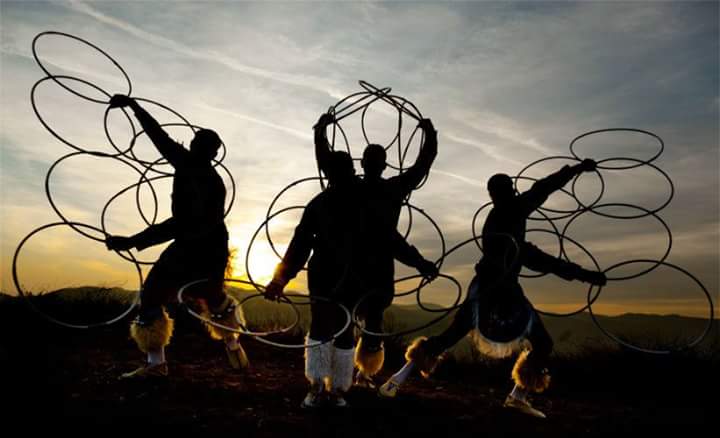
Native American Hoop Dance is a form of storytelling dance incorporating anywhere from one to thirty hoops as props, which are used to create both static and dynamic shapes, or formations, representing various animals, shapes, and storytelling elements. It is generally performed by a solo dancer with many hoops.
The first World Hoop Dance Competition was held at the New Mexico State Fair in 1991. The first World Champion Hoop Dancer was Eddie Swimmer, a Cherokee from Cherokee, North Carolina. The venue was moved to the Heard Museum in Arizona for the second event and the first adult winner of what was to become the permanent venue was Quentin Pipestem of the Tsuu T’ina Nation in Alberta, Canada. The hoop dance is part of the pan-Indian movement and as such has evolved over the years by becoming faster and incorporating many influences from outside traditional culture such as the use of moves from hip hop dance as well as the widespread use of industrial piping to construct hoops that were originally made from reeds or willow branches. Hoop dance has gained a strong following internationally as an increasing number of dancers tour the world. Twenty-one year old Nakota La Rance, already a six time World Championship winner, currently performs for the 2010-11 season of Totem by Cirque du Soleil.
During the dance, shapes are formed in storytelling ritual such as the butterfly, the eagle, the snake, and the coyote, with the hoop symbolizing the never-ending circle of life. Native American Hoop dance focuses on very rapid moves, and the construction of hoop formations around and about the body. The hoops used are typically of very small diameter (1-2.5 feet). In elaborate sequences of moves, the hoops are made to interlock, and in such a way they can be extended from the body of the dancer to form appendages such as wings and tails. The hoops are often handmade by the dancers out of simple plastic piping (though some are made of wood) and wrapped in colorful tapes, similar to the construction techniques used by non-Native American hoop-based dances.
Native American Hoop Dance has been formally recognized as a cultural heritage, embodied in both documentary films and as a living tradition in formal competition. The most popular competition occurs annually at the Heard Museum in Phoenix, Arizona. Up to 80 dancers have participated on any given year, and the competitions have drawn as many as 10,000 spectators.
Four Wind Messengers
The Four Winds are spirit beings, the Creator’s messengers, that were placed at the four corners of the world in the beginning of time by the Creator. The task of the Messengers is to attend to the cycle of the four seasons of the year.
The Messengers mind the movement of the sun, earth and stars and are charged with the responsibility of keeping a strict watch over the winds. Vigilance keeps all four winds from coming together and destroying living things on earth. In a continual state of action night and day, season through season, the Messengers are given direction by the Creator regarding what they shall do and what actions for a particular season they are to perform.
It is a matter of traditional instruction as told by the ancient priests of the original people that the individual who kills new meat shall take a part of the meat first to the priest. The priest cuts the meat into five sections, first giving a piece to the sacred fire located in the priest’s house, then, in turn, throwing a piece to the Winds of the North, South, East and lastly, West. After this is completed the meat is passed in its entirety through the sacred fire and distributed among the families. The Sun, called as “Wi ya ha” and “Wi” by certain priests and as “Tso ya” by others, has a presence upon the earth. The Sun’s earthly presence is known to the people as Fire through which the Sun, Grandmother of all that lives, sees everything that happens on earth. The Moon, Grandfather of all, is called by the priests as “To ya”.
Offerings are given to the Messengers to appease them. The offering is given to the North Wind Messenger so he will not whine too long and destroy people with cold. His color is black and his countenance, stern.
The offering is given to the East Wind Messenger so that he should not send strong east winds to overturn the young corn when it comes into tassel or roasting ears time. His color is red and his countenance is congenial.
The offering is given to the South Wind Messenger who provides the people with good and mild winds which causes all things to grow. He is a thoroughly good messenger and is highly favored by the great Ouga, or Creator, above. The South Wind’s color is yellow.
The offering is given to the West Wind Messenger who continually works to assist his superior, the South Wind Messenger. These two Messengers mix together to cause rains and bring water to the crops. The color is the West Wind is brown and his countenance is pleasant.
On occasion the North Wind Messenger sends his great cold winds to blow between the West and the South Winds, but the West Wind Messenger always joins with the South Wind Messenger and together they blow the cold north wind back to the North Wind Messenger. In summer all three Wind Messengers – the East, South and West – join together against the North Wind Messenger to ensure that his cold winds do not invade and destroy living things. Sometimes the North Wind Messenger will go about in the night to blast fruit trees, gardens, the first small corn and water. Because of the other three Winds, he must do this very secretly. Since the North Wind Messenger is capable of great mischief, the other Wind Messengers are always on their guard against his tricks and keep him in bounds.
When people do wicked things, disobey their priests and refuse to listen to their counsel, the Creator, “Ouga”, sets all four wind messengers against the earth to destroy crops and bring hunger to punish people for their wicked actions.
Color Symbolism Of The Four Winds
East Wind Messenger
The color of the East Wind is red. The name of the East Wind Messenger is “Ka na ti” which is symbolized by the Thunder Bird. “Ka na ti” is the father of the South Wind and West Wind–thunder and lightning. This spirit being controls time and space. He precedes the Sun each morning to announce her arrival.
South Wind Messenger
The color of the South Wind is yellow. The name of the South Wind Messenger is “U sa wi”, the Light Magician. This spirit being ushers in the summer seasons. Together with his twin brother, the West Wind, they manage the rain, wind and lightning throughout summer and autumn. Together they force the North Wind back to his home after his allotted time.
West Wind Messenger
The West Wind Messenger color is brown. He is called “Nuh sa wi”, the Dark Magician. The West Wind Messenger represents lightning.
North Wind Messenger
The North Wind Messenger color is black. He is called “Yah wi gu na he da”, Long Human being. This being is the spirit of all of the rivers and controls the winds that bring the winter season. He would cause great mischief if not for the watchful eyes of the South Wind and West Wind Messengers which keep him in check.
Subscrever:
Mensagens (Atom)